What Is the "Al-Aqsa Mosque" Mentioned in the Quran?
Al-Aqsa as the True Cause of the War
In our series of articles on the international legal issues of the war in the Middle East, we have repeatedly pointed out that topics such as "the rights of the Palestinian people," "occupation," and "Palestinian state" are not the cause of the conflict; on the contrary, they are constructed as instruments of this conflict.
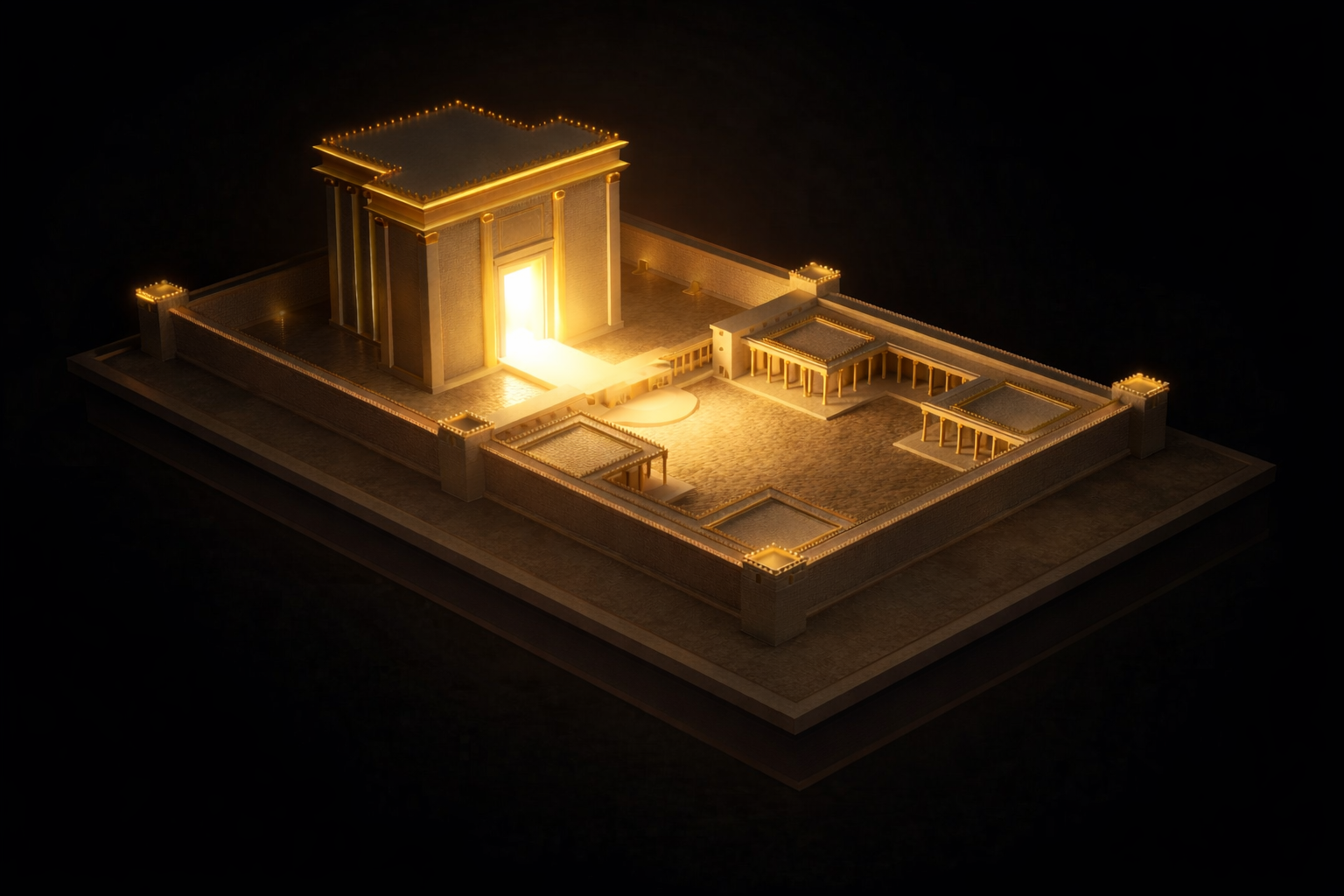
For in reality, this is a war over a holy site—over the holy Al-Aqsa Mosque, the first qibla (the direction of Islamic prayer). In the understanding of most Muslims, the Jews who have returned to Jerusalem intend to build the Third Temple on the site of Islamic holy places, which means demolishing the mosque.
The invasion of October 7, 2023, which was called precisely "Al-Aqsa Flood," is not a way to defend Gaza from the Israelis (there were none there); on the contrary, it is the sacrificing of Gaza in order to demonstrate that the war for the return of Al-Aqsa has not died out.
The Direct Text of the Quran
Surah 17 of the Quran, Al-Isra or "The Night Journey"—is for the most part devoted to Banu Israil, that is, the children of Israel.
This surah begins with the account of how Allah transported Muhammad from the Sacred Mosque to "the farthest mosque." In Arabic, "farthest" is "al-aqsa." The first ayah (verse) of this surah:
17:1 سُبْحَانَ الَّذِي أَسْرَىٰ بِعَبْدِهِ لَيْلًا مِّنَ الْمَسْجِدِ الْحَرَامِ إِلَى الْمَسْجِدِ الْأَقْصَى الَّذِي بَارَكْنَا حَوْلَهُ لِنُرِيَهُ مِنْ آيَاتِنَا ۚ إِنَّهُ هُوَ السَّمِيعُ الْبَصِيرُ
17:1 Glory to Him who made His servant travel by night from the sacred place of worship to the furthest place of worship, whose surroundings We have blessed, to show him some of Our signs: He alone is the All Hearing, the All Seeing.
(translation: M. A. S. Abdel Haleem)
Muslim tradition holds that the "farthest mosque" is the mosque in Jerusalem on the Temple Mount, and according to the text of this surah, the Night Journey was undertaken precisely to demonstrate what had happened to Banu Israil and to convey teachings addressed to Banu Israil. The phrase "whose surroundings We have blessed" also confirms that the reference is most likely to the Temple Mount.
This page contains Arabic text. To read Arabic more comfortably on multilingual pages, you may find my Chrome extension useful: [Enlarge Arabic].
The Modern Interpretation
There is a widespread view that the mosque mentioned in this passage of the Quran is the mosque currently located on the Temple Mount in Jerusalem, now called "Al-Aqsa." But this is not so.
The History of the Modern Structures
Umar ibn al-Khattab conquered Jerusalem in 637 CE. According to tradition (sources: al-Tabari, Eutychius of Alexandria), he built a simple wooden prayer house (musalla) in the southern part of the Temple Mount—a temporary structure that was not a full-fledged mosque.
The present stone mosque called "Al-Aqsa" was erected under the Umayyads: construction began under Abd al-Malik ibn Marwan around the 690s CE, and was completed under his son al-Walid I around 705–715 CE. The building was rebuilt multiple times following earthquakes.
The Quran was recorded during Muhammad's lifetime from 610 to 632 CE, and was finally codified under Caliph Uthman around 650 CE.
That is, the Quran cannot be referring to it.
Simply because at the time the Quran was being dictated, it did not exist. What stands there now is a late structure, having no relation to ayah 17:1.
The True Al-Aqsa
If the present mosque did not exist in the time of Muhammad, then what is this "mosque" in Jerusalem that was written about in the Quran?
The answer to this can be found in the subsequent text (ayahs 2–7) of the same surah:
"2. We also gave Moses the Scripture, and made it a guide for the Children of Israel. 'Entrust yourselves to no one but Me, 3. you descendants of those We carried with Noah: he was truly a thankful servant.' 4. We declared to the Children of Israel in the Scripture, 'Twice you will spread corruption in the land and become highly arrogant.' 5. When the first of these warnings was fulfilled, We sent against you servants of Ours with great force, and they ravaged your homes. That warning was fulfilled, 6. but then We allowed you to prevail against your enemy. We increased your wealth and offspring and made you more numerous–– 7. whether you do good or evil it is to your own souls––and when the second warning was fulfilled [We sent them] to shame your faces and enter the place of worship as they did the first time, and utterly destroy whatever fell into their power."
(translation: M. A. S. Abdel Haleem)
Pay attention to the phrase "and enter the place of worship (masjid) as they did the first time."
In the Arabic original, "and to enter the mosque" is: وَلِيَدْخُلُوا۟ ٱلْمَسْجِدَ
This page contains Arabic text. To read Arabic more comfortably on multilingual pages, you may find my Chrome extension useful: [Enlarge Arabic].
Most Islamic theologians agree that ayah 5 refers to the destruction of the First Temple (the Temple of Solomon) and the loss by the Jews of their land, while ayah 7 narrates the capture by enemies of the Jewish Second Temple, just as had once happened with the First, and the second expulsion of the Jews from Jerusalem.
Here it should be noted that in both the first ayah, which speaks of the farthest mosque, and in the seventh, which speaks of the mosque of the Jews that the enemies invaded, one and the same word مسجد (masjid) is used, which is usually translated as "mosque."
What "mosque," then, was located in Jerusalem, on the Temple Mount, before the construction of the mosque there by Caliph Umar?
The answer, based on the text of ayah 7: the Temple on the Temple Mount, the remains of which are there to this day.
The First Qibla
Toward what, then, did Muslims originally pray, including Muhammad (the first qibla from 610 to 625 CE)?
It is reported that Muhammad's companion Al-Bara' ibn Azib said:
"When the Prophet (ﷺ) came to Medina, he ... offered his prayers facing Bayt al-Maqdis (Jerusalem) for sixteen or seventeen months, but he wished that he could pray facing the Ka'ba (at Mecca)"
Source: Sahih al-Bukhari 40 (Some theologians consider Sahih al-Bukhari the most authentic Islamic book after the Quran.)
What is "Bayt al-Maqdis" (بَيْتِ الْمَقْدِسِ)?
This is a borrowing from Hebrew; in Hebrew it is "Beit HaMikdash" (בֵּית הַמִּקְדָּשׁ). This is the Hebrew name for the Holy Temple.
Bayt/Beit means house, building. Al-Maqdis/HaMikdash means sacred, holy, pertaining to the Temple. Subsequently, in Islam, the term "Bayt al-Maqdis" came to denote Jerusalem in general. But originally "Bayt"/"Beit" is precisely "house," "building," not a city in general.
That is, the first qibla (direction of prayer) is the Al-Aqsa Mosque, which is the same as "Bayt al-Maqdis" / "Beit HaMikdash"—that is, the Jerusalem Temple.
The Quran on the Return of the Israelites
According to the Quran, can Banu Israil once again regain what was twice lost? Yes, this possibility is directly stated in the Quran in the same surah (17:8):
Your Lord may yet have mercy on you, but if you do the same again, so shall We: We have made Hell a prison for those who defy [Our warning].
The Torah says something similar.
Al-Aqsa as "a House of Prayer for All Peoples" and the Key to Ending the War
Based on this, Muslims have no theological grounds to oppose the restoration of the real Al-Aqsa on the Temple Mount and the demolition of temporary structures, which are not the sanctuary of Islam, but on the contrary, what conceals and tramples (albeit perhaps unintentionally) the true sanctuary of Islam - what was the first Qibla.
For this would be the restoration of that very true "Al-Aqsa Mosque" of which the Quran speaks, that very Temple ("Bayt al-Maqdis") toward which Muhammad himself prayed until 625 CE.
The present (temporary) Muslim structures on the Temple Mount did not exist at the time of the writing of the Quran, and their demolition, necessary for the restoration of the true Al-Aqsa and the rebuilding of this ancient Temple, is thus a return to the true holy sites of Islam.
Thus the restored Al-Aqsa will be a holy site and a place of prayer for Jews, for Muslims, for Christians, and for other peoples united in an honest, sincere striving toward the Most High, as stated in the ancient prophecy:
"Even them will I bring to My holy mountain, and make them joyful in My house of prayer; their burnt-offerings and their sacrifices shall be acceptable upon Mine altar; for My house shall be called a house of prayer for all peoples."
(Isaiah 56:7)
Links and references:
https://en.wikipedia.org/wiki/Temple_denial
Publications and discussions:
Discussion on Facebook of an earlier version of this article