Sadducees and Pharisees

As a continuation of my posts on Hanukkah and of my discussions with Rav Michael Jedwabny—see Hanukkah, The Son of the Star and the “Three Oaths”, The Storming of Heaven and the History of Hanukkah—discussions in which, it seems to me, there were interesting and profound thoughts on both sides—I noticed a historical circumstance to which I had not previously paid attention:
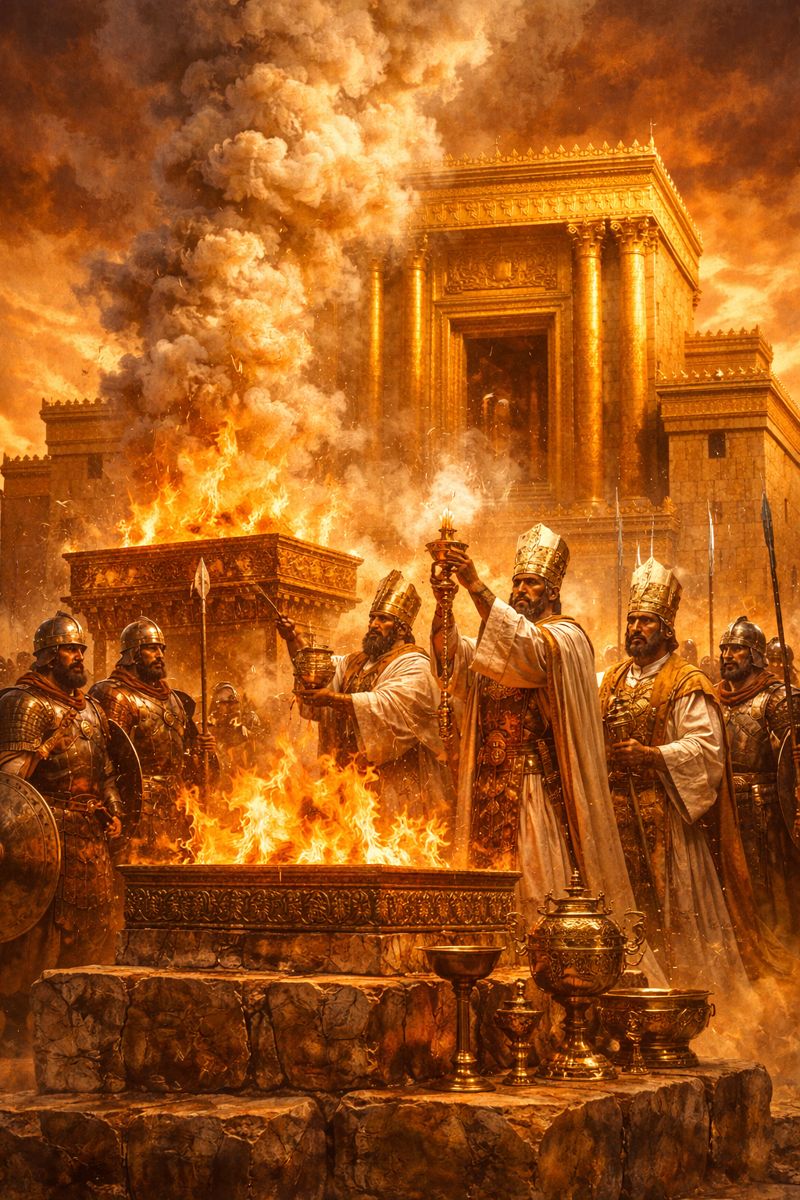
The Hasmonean dynasty was a dynasty of priests—kohanim (כֹּהֲנִים)—that is, it belonged to the tradition of the Sadducees (צְדוּקִים), who were the dominant, or official, form of Judaism before the destruction of the Temple. By contrast, the Talmud–Shulchan Arukh tradition represents the line of their ideological opponents within Judaism—the Pharisees (פְּרוּשִׁים), perushim, “the separated ones.”
In other words, the Maccabees—the Hasmoneans—really did embody a different Judaism, one that differed sharply and fundamentally, in ideological terms, from Pharisaic Judaism.
A clarification is necessary here: in Christian tradition, the word “Pharisaic” acquired a negative meaning—hypocrisy, sanctimoniousness, ostentatious righteousness—although ideologically Jesus himself was precisely a Pharisee and conducted his polemics within Pharisaic discourse, as did the founder of Christianity, the Apostle Paul. In this text, I attach no negative meaning to the term “Pharisaic,” using it simply as a historical term.
The Sadducees represented the tradition of the priests (kohanim) and of the Temple attendants. In their worldview, the role of the priests and of the Temple was central.
In fact, I have already pointed out that the Maccabees fought first and foremost for control of the Temple and for the ability to continue the Temple service—something without which they could not conceive of Judaism. In other words, it was not enough for them to hide away, study Torah, and observe Shabbat and kashrut (that is the vision of Judaism characteristic of the exilic tradition); for them, it was a matter of principle to hold authority over the Temple and to fulfill the role assigned to the kohanim.
The ideological differences between the Sadducees and the Pharisees were substantial.
On matters of religious doctrine, the sources point to the following features of the Sadducean worldview:
- denial of the immortality of the soul and the resurrection of the dead (a position that follows quite directly, in particular, from the Book of Kohelet (Ecclesiastes)),
- denial of angels as independent entities.
These differences are also noted in early Christian sources: “For the Sadducees say that there is no resurrection, neither angel, nor spirit: but the Pharisees confess both” (Acts 23:8).
As is easy to see, from the standpoint of strict adherence to Rambam’s Thirteen Principles of Faith—specifically the thirteenth principle—the Sadducees would seem, by that standard, to fall outside the bounds of Judaism altogether. And yet, in the age of the Temple, it was precisely the Sadducees who represented the dominant and traditional form of Judaism. This creates a striking paradox: the high priests who lit the Menorah in the Temple would, from the point of view of a present-day rabbi “from Bnei Brak,” be heretics.
The confrontation between the defenders of the priestly tradition—the Sadducees—and the “separated ones,” the Pharisees, was severe—so severe that in the 90s BCE it became a civil war that lasted about six years, under the Hasmonean king Alexander Jannaeus, who also held the office of high priest and who crushed the Pharisees and executed their leaders.
According to Josephus, the Pharisees were regarded as “the most skillful interpreters of the laws.” The Sadducees, by contrast, were conservatives, supporters of a literal reading and understanding of the ancient scriptures. Yet the majority of the people were ideologically closer to the Pharisees than to the Temple aristocracy. As Josephus wrote:
“And concerning these things it is that great disputes and differences have arisen among them, while the Sadducees are able to persuade none but the rich, and have not the populace obsequious to them, but the Pharisees have the multitude on their side.”
(Antiquities XIII, 298)
In the Pharisaic conception, the Temple and the Temple service were not the essential load-bearing structure, while the priestly estate was perceived more as an adversary. In the end, the Temple was physically destroyed, and the priestly estate was broken. But Pharisaic Judaism was far better adapted to life without the Temple and without the Temple service, and it replaced the aristocratic institution of the priests (kohanim)—whose role in the Pentateuch was central and unshakable—with the more “democratic” institution of the rabbis. The Pharisees could survive in exile; the Sadducees could not.
The key moment here is the story told in the Talmud, in Gittin 56b:5. During the siege of Jerusalem, the Pharisaic leader Rabban Yohanan ben Zakkai escapes from the city and reaches an arrangement with the Romans. When Vespasian, who commanded the siege and later became emperor, says, “Ask of me whatever you wish,” Ben Zakkai replies: “Give me Yavne and its sages” (תן לי יבנה וחכמיה). He does not ask that the Temple be saved. He asks for his own Sanhedrin—the Pharisaic one: without the Temple and without the Temple aristocracy, in Yavne rather than in Jerusalem. About a year later, the Temple was destroyed.
One may therefore say that Pharisaic (that is, Talmudic) Judaism was a beneficiary of the catastrophe of 70 CE—and perhaps, in that sense, one of its spiritual causes as well (which, incidentally, resonates in an interesting way with what is said in the Quran, although Muhammad himself could not have known all these historical details).
Thus, the rejection by modern Pharisees of the idea of restoring the Temple and the Temple service—which also implies the restoration of the role of their ideological rivals, the priestly estate—is not merely a legacy of the “Judaism of exile.” It reaches back to a much earlier period: the confrontation between the Pharisees and the ancient Temple aristocracy.
Post and discussion on Facebook (in Russian)